
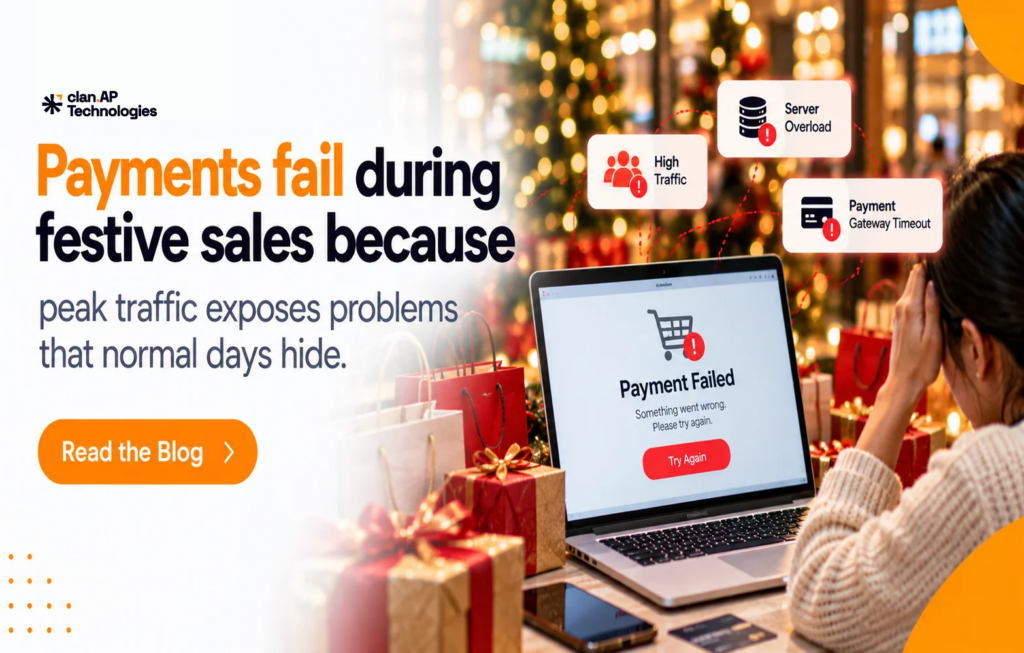
Most festive sale payment failures are not random. They come from gateway timeouts, retry logic that charges twice, expired tokens, fraud rules that block real buyers, and third-party services that slow down under load. Each of these can be found before the sale starts. Payment gateway testing at peak-level traffic, across every payment method and failure path, is how you find them. This post covers why checkouts break during Black Friday, Cyber Monday, Christmas, Diwali and Eid sales, and the tests that stop it from happening to you.
Why payments fail during festive sales
A checkout that works fine on a quiet Tuesday can break on sale day. The code has not changed. The conditions have. These are the most common causes.
1. Gateway timeouts under load. Your payment provider, your bank partners and your own servers all slow down when traffic spikes. If your app gives up waiting too early, a payment that actually went through is shown to the buyer as failed.
2. Retry logic that charges twice. When a request times out, many apps retry it. Without idempotency keys, the retry can create a second charge. The buyer sees two debits and opens a dispute.
3. Webhooks that arrive late or out of order. Payment status often comes back through webhooks. At peak, these can be delayed. Many providers, Stripe included, also do not guarantee the order events arrive in. Orders get stuck in “pending”, or stock is released while the buyer has already paid.
4. Fraud rules that block real buyers. Sale traffic looks unusual: new customers, bigger baskets, many orders from one region in a short time. Fraud rules tuned for normal days can decline good orders.
5. 3D Secure and OTP steps that fail. Strong customer authentication adds a redirect or a one-time password. If that step is slow or breaks on a certain browser or bank app, the buyer drops off.
6. Local payment methods that were never tested properly. Wallets, UPI, buy now pay later and regional cards each have their own flows. A festive sale is often the first time some of them get real volume.
7. Coupon, tax and currency edge cases. Sale-only discounts, stacked coupons, rounding and multi-currency pricing can produce a total that the gateway rejects, or a total that is simply wrong.
8. Last-minute releases. Teams often push a new banner, a new promo engine or a checkout tweak just before the sale. Untested changes close to peak are one of the most common sources of failure.
What a failed checkout really costs at peak
A payment failure on sale day costs more than one lost order. The buyer is ready to pay, the intent is high, and the sale window is short. If the checkout fails, most buyers will not wait for a fix. They try once more, then shop somewhere else.
The damage also continues after the sale:
- Support load. Every double charge or stuck order becomes a ticket, a chat or a call.
- Refunds and disputes. Duplicate charges lead to refunds, chargebacks and fees from your payment provider.
- Trust. A buyer who saw an error at checkout is less likely to save their card with you next time.
- Team time. Engineers spend the busiest week of the year firefighting instead of watching the numbers.
The good news is that most of these failures can be reproduced in a test environment weeks before the sale.
How testing prevents payment failures
Good payment gateway testing does not just check that a card goes through. It checks what happens when things go wrong, at the traffic you expect on sale day. Each common failure maps to a specific test.
Festive sales bring increased traffic and transaction volumes, making payment systems more vulnerable to failures. Software testing helps businesses identify and prevent these issues before they impact customers.
- Gateway Timeouts: Load and stress testing ensure checkout remains stable during peak traffic.
- Double Charges: API testing verifies that payment retries do not create duplicate transactions.
- Webhook Failures: Webhook testing checks delayed, duplicated, or out-of-order payment updates.
- Fraud Rule Errors: Testing helps reduce false declines of legitimate customer transactions.
- 3D Secure and OTP Drop-Offs: End-to-end testing identifies authentication issues across browsers and mobile devices.
- Local Payment Failures: Payment method testing validates wallets, cards, and regional payment options.
- Coupon, Tax, and Currency Errors: Data-driven testing verifies discounts, taxes, and currency calculations.
- Release-Related Bugs: Automated regression testing checks critical checkout flows after every update.
Download the Pre-Sale Payment Testing Checklist
When to start: a pre-sale testing timeline
Payment testing that starts the week before the sale is too late to fix what it finds. Work back from your sale date.
- 6 to 8 weeks before: map every payment flow, method and region. Agree what “peak traffic” means for this year.
- 4 to 6 weeks before: build or update automated tests for checkout, refunds, webhooks and failure paths. Run the first load test.
- 3 to 4 weeks before: fix what the first round found. Run load tests again at peak plus a margin. Test fraud rules with sale-like orders.
- 2 weeks before: full regression on checkout across browsers, devices and payment methods. Agree the code freeze.
- Sale week: only urgent fixes, each one followed by a regression run. Watch payment success rates live.
- After the sale: review what failed, what almost failed and what to add to the test suite for next time.
Short on time before the sale? Where AI-assisted QA helps
Many teams know they need this testing but do not have the weeks to write every script by hand. This is where AI-assisted QA fits.
At clan.AP Technologies, AI tools help build test scripts for checkout, API and payment flows much faster than writing them from scratch. A QA expert then reviews every script before it reaches you. The expert checks that the test covers the right failure paths, uses the right test data and actually fails when it should. That review matters most in payments, where a test that passes for the wrong reason gives false confidence.
What this means for a team preparing for a sale:
- Running in days, not weeks, so testing can start even when the sale is close.
- A guaranteed minimum number of scripts, so you know what coverage you are getting.
- You own every script. They run in your CI/CD pipeline, and there is no lock-in.
- Domain experience in payments, fintech and POS, so edge cases like retries, webhooks and refunds are covered from the start.
- Clear reports your product and engineering leads can read in minutes.
AI speed with human reliability, so you can release with confidence at AI speed.
FAQs
What is payment gateway testing?
It is testing how your app talks to your payment provider: successful payments, declines, refunds, timeouts, retries, webhooks and authentication steps. Good payment gateway testing covers what happens when things go wrong, not just when they go right.
Why do payments fail more during sales than on normal days?
Higher traffic slows down every system in the payment chain. Timeouts, retries, delayed webhooks and strict fraud rules all show up more under load. Last-minute releases before a sale add more risk.
Can I test payments without real money?
Yes. Most payment providers offer a sandbox or test mode with test cards and test accounts. These let you simulate approvals, declines, 3D Secure and refunds safely.
How early should we start testing before a festive sale?
Ideally 6 to 8 weeks before. That leaves time to find problems, fix them and test again. If the sale is closer, AI-assisted QA can get tests running in days.
Does load testing the website cover payments?
Not on its own. A load test should run through the full checkout and payment flow, including webhook handling. Many providers rate-limit their sandboxes, so follow their load testing guidance and use a mock of the gateway where needed. Testing only the home page or product pages misses where most sale-day failures happen.
Will testing guarantee no payment issues on sale day?
No testing can promise that. It does find most known failure types early, and it gives your team a clear picture of the risks that remain.
Get your checkout ready before the next sale
If you have a festive or year-end sale coming up, now is the time to test your payment flows under real sale conditions. clan.AP Technologies has helped payments, fintech and POS teams test checkout and payment flows since 2020.
Book a 30-minute discovery call. We will look at your payment setup, your sale date and where the biggest risks are, and agree a clear testing scope.