
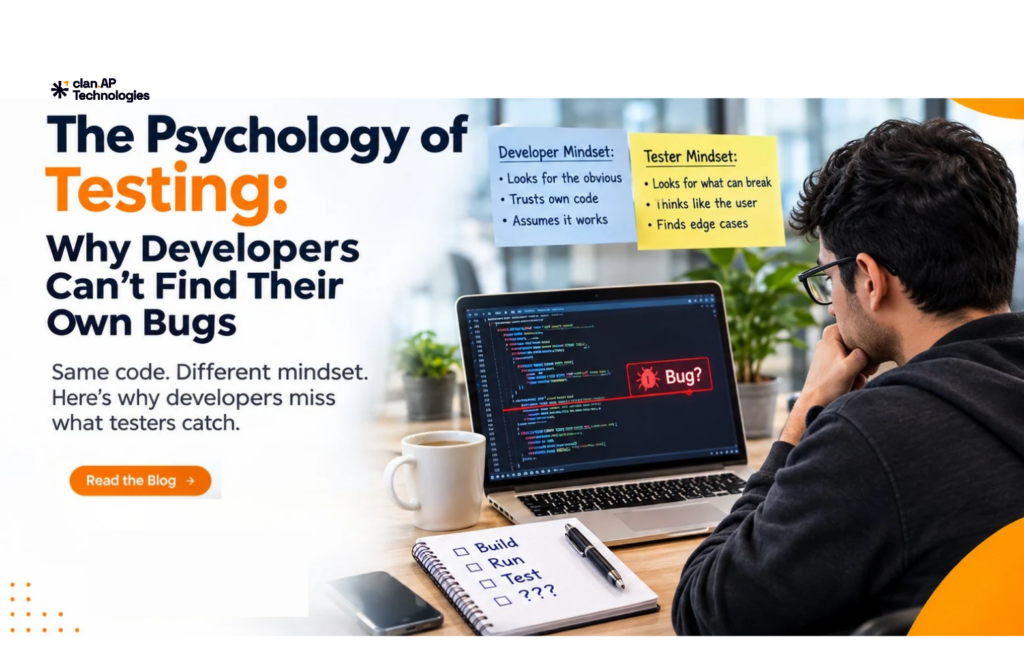
Developers can’t find their own bugs because their brain tests what they meant to build, not what they actually built. This is confirmation bias. Research shows people testing software run about four times as many tests that prove it works as tests that try to break it. The fix is not better developers. It is a second, independent set of eyes whose job is to find what the author cannot see.
If you lead an engineering team, this explains why bugs still reach production after careful code reviews and green unit tests. It also explains what to change.
Key takeaways
- Developers test to confirm their code works. Testers test to prove it fails. Both are needed.
- Studies found testers ran about 4 positive tests for every 1 test that challenged the program.
- The more familiar you are with code, the more your brain fills gaps you can no longer see.
- The July 2024 CrowdStrike outage, which hit about 8.5 million Windows devices, passed an automated validator that missed the fault.
- Independent QA works best as an embedded team that shares your sprints, not a final gate.
Want a second set of eyes on your next release? Book a 30-minute discovery call and we’ll walk through where bugs are slipping past your team.
Why can’t developers find their own bugs?
Developers miss their own bugs because of how the human brain checks its own work. Skill and effort don’t change this. Four effects stack on top of each other.
1. Confirmation bias: you test to prove you were right
Confirmation bias is the habit of looking for evidence that supports what you already believe. In testing, it means checking that code works instead of trying to make it fail.
Researchers Leventhal, Teasley and colleagues studied this in the 1990s. They found testers ran about four times as many “it works” tests as tests that challenged the program. More experience reduced the bias but did not remove it.
A later study by Calikli and Bener at a large telecom company found a direct link between developers’ confirmation bias levels and how many defects their code had.
2. Author blindness: your brain fills the gaps
When you reread your own writing, you see what you meant to type, not what is on the screen. Code works the same way. The developer knows the intended logic, so the brain quietly “autocorrects” a missing check or a wrong boundary.
A fresh tester has no intent to fill in. They only see what the software actually does.
3. The happy path trap
Developers build features from the requirement: “user enters a valid card and pays”. So they test that exact flow. The bugs usually live elsewhere:
- An expired card at midnight on the last day of the month
- Two taps on “Pay” on a slow network
- A POS terminal that loses Wi-Fi mid-transaction
- A field with 21 values when the code expects 20
The early studies found the same pattern. Testers mostly checked what the specification said the software should do, and rarely what it should not do.
4. Familiarity and time pressure
Code that passed last week feels safe this week. A component with a clean history gets less attention, even after a small change. Add a sprint deadline, and “it worked on my machine” becomes the test plan.
What does the developer mindset vs the tester mindset look like?
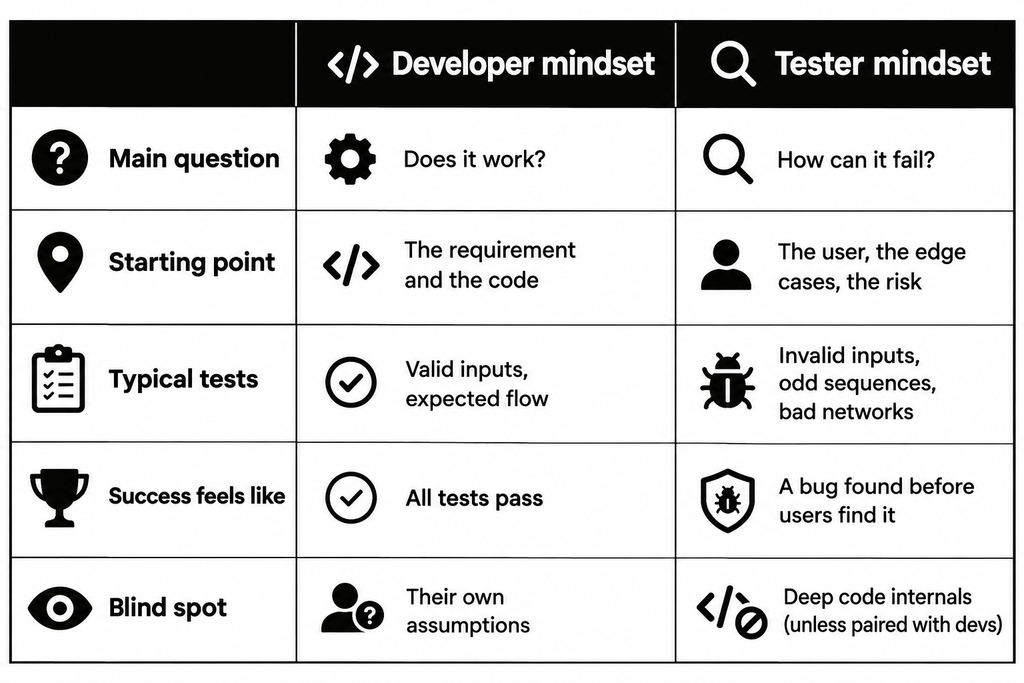
Neither mindset is better. Good software needs both, held by different people.
Why this matters: what happened in the CrowdStrike outage?
The CrowdStrike outage of July 19, 2024 shows what happens when a system is trusted because it passed checks before.
What happened. CrowdStrike pushed a content update to its Falcon security sensor on Windows. Machines that received it crashed and got stuck in reboot loops around the world.
The impact. Microsoft estimated the update affected about 8.5 million Windows devices, less than 1% of all Windows machines. Because many of those machines ran airline and point-of-sale systems, the disruption was felt worldwide.
The cause, as reported. According to CrowdStrike’s root cause analysis, a template expected 21 input fields, but the code that fed it supplied only 20. The company said a bug in its Content Validator let the faulty file pass, and the sensor then read memory out of bounds and crashed. CrowdStrike also said this type of content update had not been put through the same testing as full software releases. Help Net Security summarizes the full analysis here.
What testing would likely have caught it. CrowdStrike’s own fixes point to the answer: testing each new content file inside the real interpreter, checking that input counts match, and rolling updates out in stages with canary testing first. In short, independent release testing and staged deployment, instead of trusting a check that had worked before.
How clan.AP tests for this risk. Our QA team treats every release, config change and content update as untested until proven otherwise. We run release and regression checks on the real build, test boundary values like “20 vs 21 inputs”, and help teams set up staged rollouts. That is the tester mindset applied to the whole release, not just the code diff.
The lesson is not that CrowdStrike’s engineers were careless. It is that any team, even a large and skilled one, can come to trust its own process. Independent testing exists to question that trust.
Is developer testing enough, or do you need independent QA?
The International Software Testing Qualifications Board (ISTQB) teaches the same idea in its Foundation syllabus. Tests designed by the code’s own author have the lowest level of independence. Independence helps avoid author bias.
Developer testing is necessary but not enough on its own. Unit tests and code reviews catch logic errors early and cheaply. Independent QA catches what the author’s assumptions hide: edge cases, integration gaps and real-user behavior.
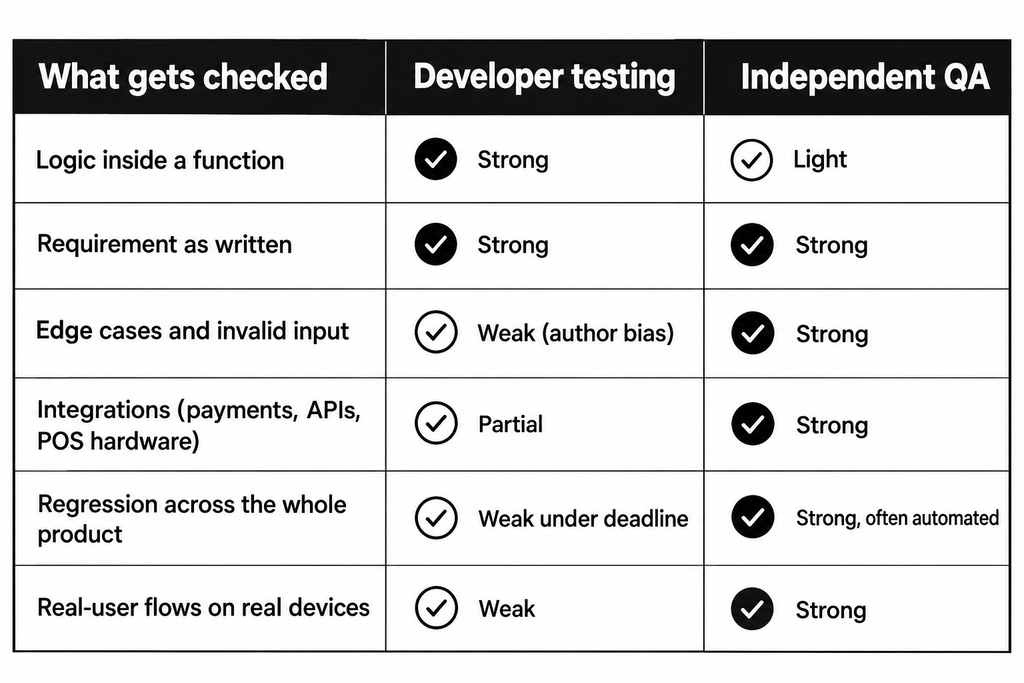
What does “independent” mean in practice?
Independent does not mean distant. The most effective setup is a QA team that:
- Joins your sprint planning and reads stories before code is written
- Writes test cases from the user’s view, not the developer’s
- Pairs with developers on tricky areas, without owning the code
- Runs regression on every build, not just before launch
- Reports bugs with clear steps, screenshots and severity
Stuck in a cycle of hotfixes after every release? Visit our website to see how an embedded QA team can strengthen your testing process and help you ship with confidence.
What does clan.AP’s Full QA Team do differently?
With Your Full QA Team for the Cost of One, you get a full QA team that works as your ongoing, embedded QA function, for about what you would pay one QA engineer locally. It is a smarter use of a budget you already have.
- Built-in independence: Our testers did not write your code, so they don’t share its assumptions.
- Embedded, not bolted on: We join your sprints, tools and stand-ups, so bugs are caught while the code is fresh.
- Manual and automated: Exploratory testing finds the odd cases. Automated regression keeps old bugs from coming back.
- Domain experience: Food and hospitality POS, payments and fintech, and B2B SaaS, where edge cases cost real money.
- Clear reporting: Every bug comes with steps, evidence and severity, so developers can fix it fast.
We don’t promise zero bugs. No honest QA team can. We promise that fewer of them reach your users. Scope is confirmed in one 30-minute call.
Frequently asked questions
Why can’t developers test their own code effectively?
Developers can test their own code, but they tend to test that it works rather than how it fails. This is confirmation bias. They also know what the code is meant to do, so their brain fills gaps a fresh tester would spot.
What is confirmation bias in software testing?
Confirmation bias in software testing is the habit of choosing tests that prove the software works. Studies from the 1990s found testers ran about four times as many confirming tests as challenging ones.
Should developers still write tests if we have a QA team?
Yes. Unit tests and code reviews catch logic errors early and cheaply. Independent QA adds a second layer focused on edge cases, integrations, regression and real-user flows. The two work best together.
Does independent QA slow down releases?
Not when QA is embedded in your sprints. Testers review stories early, test as features land and automate regression. This usually means fewer hotfixes after release, which saves more time than it costs.
What is the difference between QA and testing?
Testing checks whether software works. Quality assurance covers the whole process: reviewing requirements, planning tests, running them, and improving how the team builds software so fewer bugs appear in the first place.
Get a second set of eyes on your product
Your developers are not the problem. Asking them to be both author and critic is. Contact Us to see where an embedded QA team fits into your release cycle.