

A coffee order looks simple. One drink, one payment, done. But behind the counter, that order touches the menu, the price rules, the payment terminal, the kitchen screen, the receipt and often a loyalty app. Each step is a place where software can fail.
That is why a coffee order is one of the best ways to understand software testing. Testing is not just checking that the happy path works. It is checking every path a real customer might take, including the strange ones, and making sure tomorrow’s update does not break today’s order.
Let’s walk through one order and see what it teaches us.
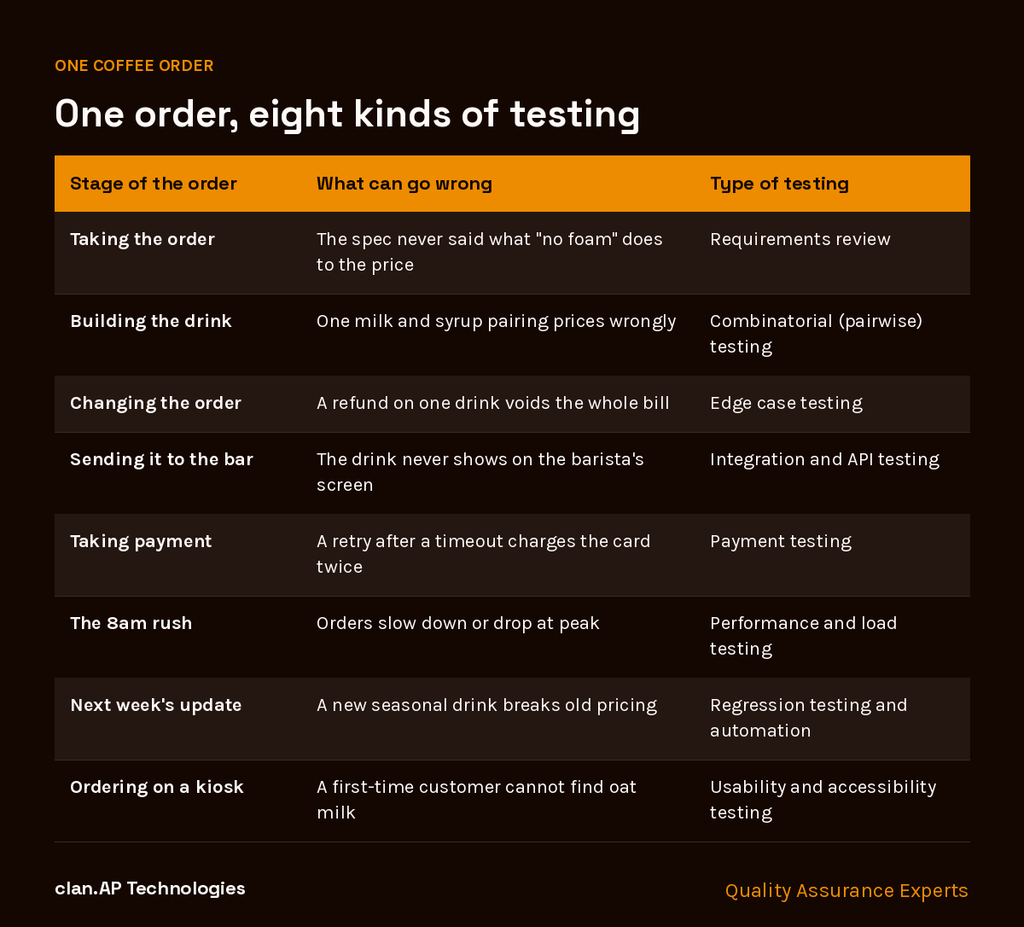
One order, eight kinds of testing
Here is the whole journey at a glance. Each row is a stage of one coffee order and the kind of testing that protects it.
1. The order: “A large flat white, oat milk, extra shot, no foam”
Before anyone writes a test, someone has to ask questions about the requirement. Does oat milk cost extra? Does “no foam” change the price? Can a flat white even come in large, or should the system block that choice?
This is requirements testing. Many bugs start as unclear specs, not bad code. A QA team that reviews requirements early catches these gaps before they are built into the product, when fixing them costs the least.
Testing lesson: quality starts before the first line of code.
2. Modifiers multiply fast
Now add the menu. Imagine a small café with 3 sizes, 5 milk options, 4 shot options and 6 syrups. That is 3 × 5 × 4 × 6 = 360 possible drinks, before you add temperature, sweetness or extra toppings.
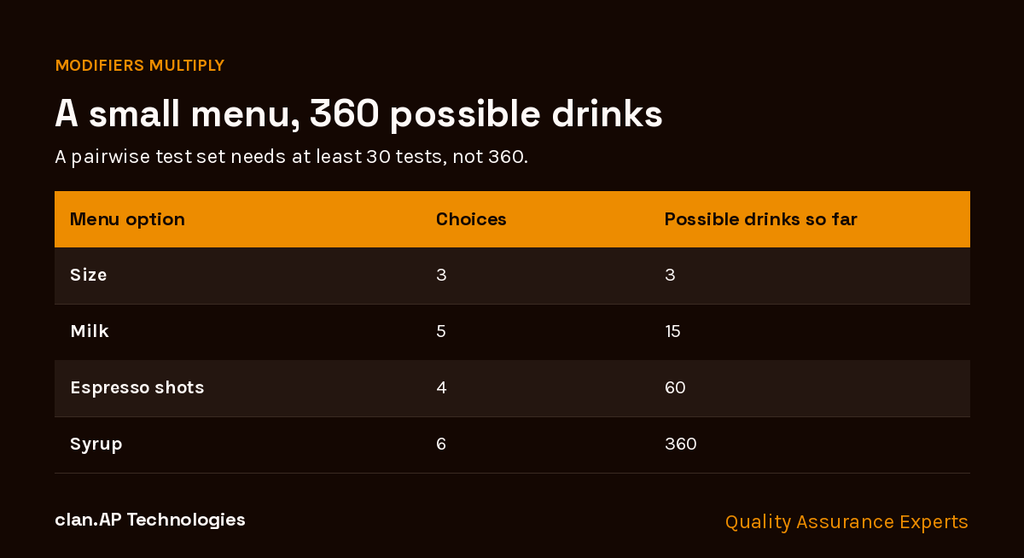
No team can test every combination by hand on every release. Good QA uses techniques like pairwise testing, which picks a smart set of combinations that still covers how options interact. The goal is not to test everything. It is to test the right things.
This approach is backed by research. Studies by the US National Institute of Standards and Technology (NIST) found that most software failures are caused by one or two parameters interacting, with fewer caused by three or more. In other words, a bug is far more likely to sit between “oat milk” and “large” than in one rare six-option drink.
For our small café, a pairwise test set needs at least 30 tests (6 syrups × 5 milks), not 360. That is the kind of saving that makes deep coverage realistic on every release. NIST also notes that pairs alone are not always enough, so higher-risk flows like payments may need three-way combinations too. Its combinatorial testing FAQ is a good place to start.
Testing lesson: test design matters more than test volume.
3. The customer changes their mind
Real customers do not follow the script. Here is what that looks like at the counter:
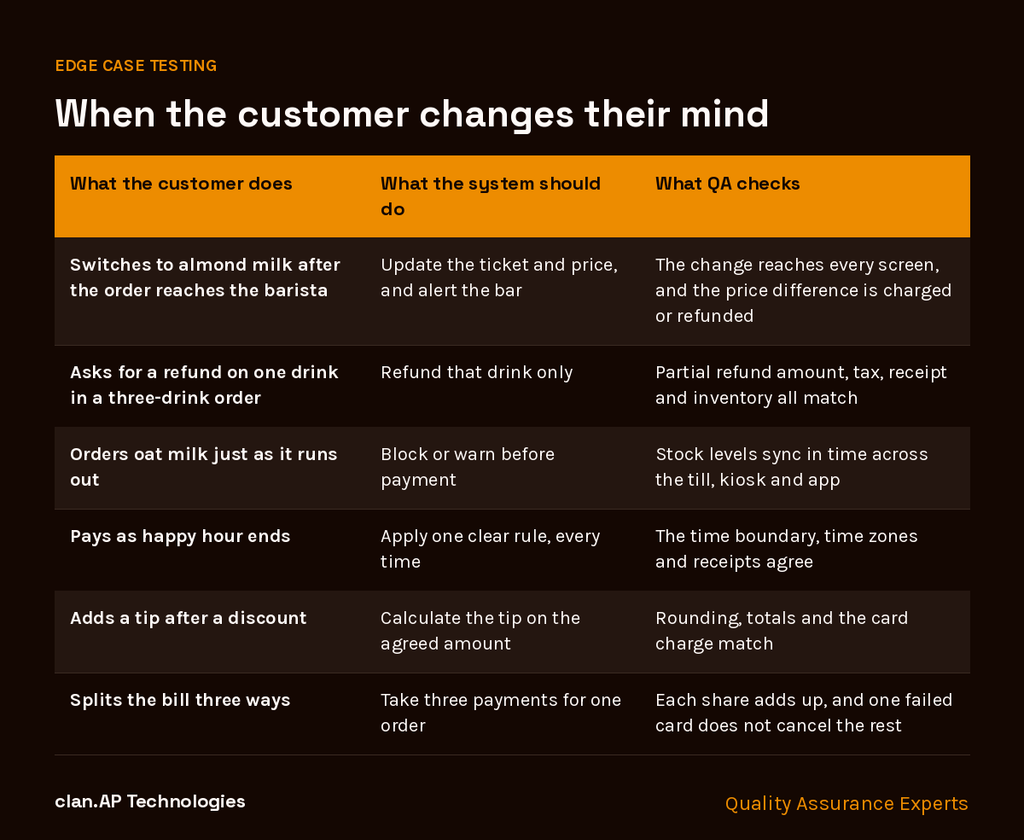
These are edge cases. They are rare for one customer, but across thousands of orders a day they happen all the time. Edge case testing is where many of the bugs that reach real users are hiding.
A useful habit is boundary testing: checking values right at the edge of a rule. If happy hour ends at 5:00pm, test 4:59, 5:00 and 5:01. If a loyalty reward unlocks at 10 stamps, test 9, 10 and 11. Many pricing bugs live exactly on these lines.
Testing lesson: the unhappy paths deserve as much attention as the happy one.
4. The order has to travel
Once the order is placed, it does not stay in one place. It goes to the kitchen display, the receipt printer, the inventory system, the loyalty app and sometimes a delivery platform. Each handoff is an integration, and each integration can fail quietly.
Integration and API testing checks that data arrives complete, in the right format and at the right time. A drink that shows on the till but never reaches the barista’s screen is a lost sale and an unhappy customer.
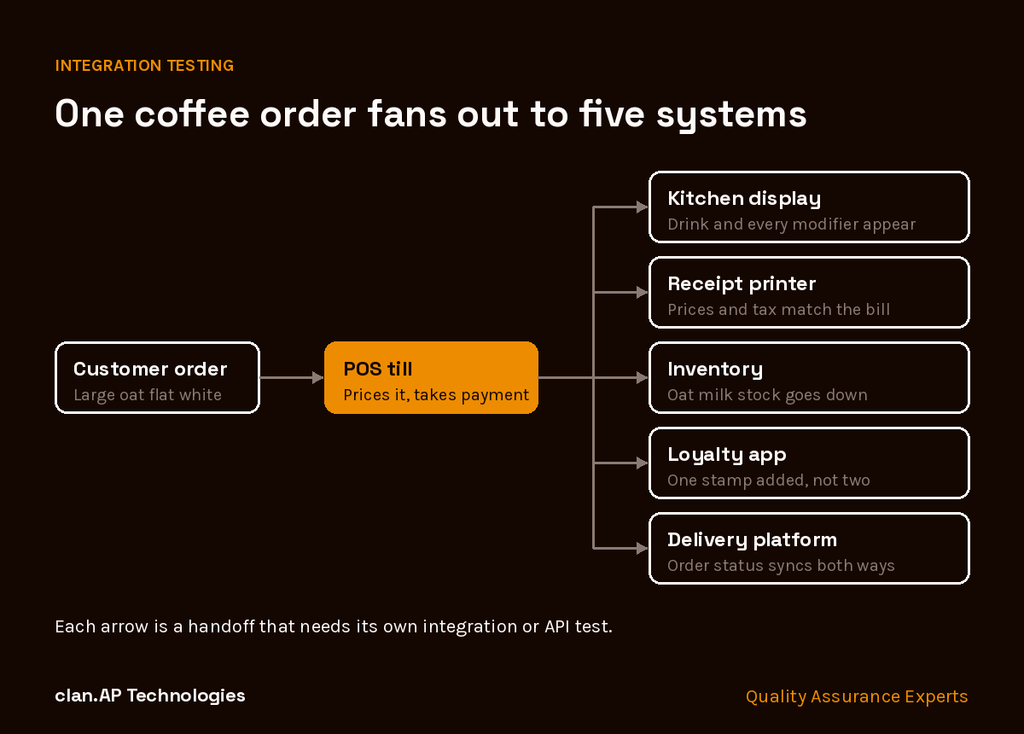
Where one coffee order travels · 1 till, 5 connected systems
A bug in any one of these handoffs can turn a correct order into a wrong drink, a wrong receipt or a missing loyalty stamp.
Testing lesson: a feature is only as good as its connections.
5. The payment is where trust lives
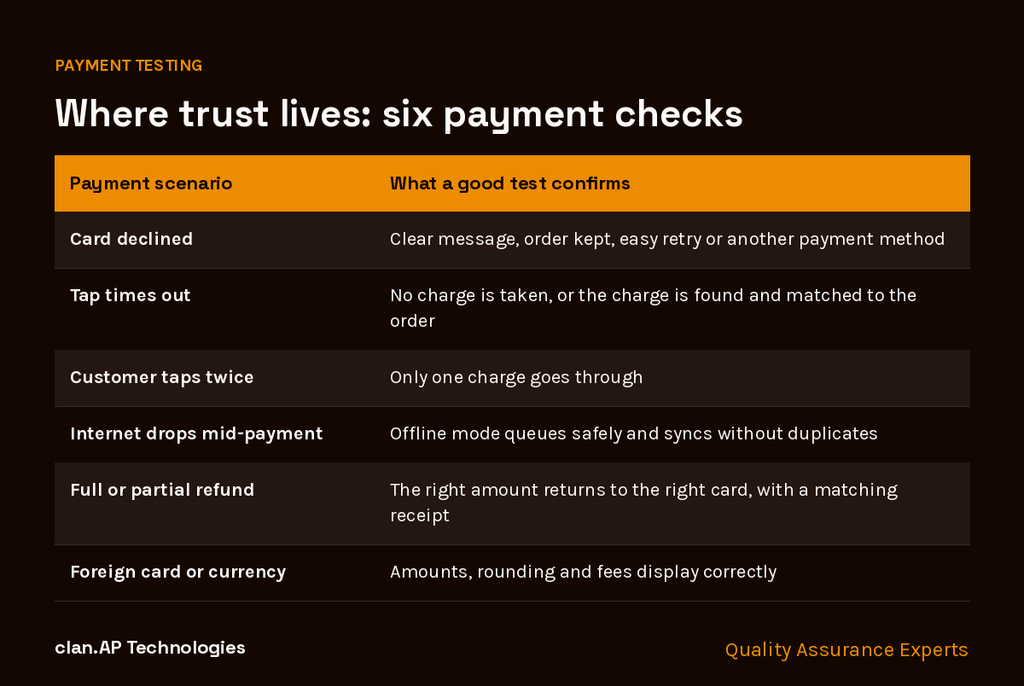
Payment is the moment customers notice most. What happens if a card is declined? If the tap times out? If the internet drops halfway through, and the customer taps again? Do they get charged twice?
Payment testing covers declines, timeouts, retries, refunds, offline mode, rounding and receipts. In POS and fintech products, these flows need careful, repeatable testing, because one double charge can cost a customer for good.
Security matters here too. Any business that stores, processes or transmits card data falls under the PCI Data Security Standard (PCI DSS), set by the PCI Security Standards Council. QA does not replace a formal compliance assessment, but testing can confirm that card details never appear in logs, receipts or error messages, and that payment screens behave safely when something fails.
Testing lesson: test the moments that affect trust first.
6. Then the morning rush hits
One order working at 3pm says little about the 8am rush. When dozens of orders arrive at once across several terminals and an online ordering app, slow responses and dropped orders start to appear.
Performance and load testing checks how the system behaves under real pressure, before real customers find out.
Good load testing starts with real questions, not a random number of virtual users:
- How many orders arrive in your busiest 15 minutes, across tills, kiosks and the app?
- How long can a customer wait at checkout before they give up?
- What happens to the order queue if the kitchen display reconnects mid-rush?
- Do online orders and walk-in orders still land in the right sequence?
The answers become test scenarios that mirror a real Monday morning, and the results show where the system bends before it breaks.
Testing lesson: test for your busiest day, not your average one.
7. Tomorrow, the menu changes
Next week the café adds a seasonal drink and a new loyalty offer. The developers update the code. Does the large oat flat white still price correctly? Does the refund flow still work?
This is regression testing: checking that new changes have not broken what already worked. Because it repeats with every release, it is the best place for test automation. Automated regression suites let teams release often without retesting everything by hand.
A well-built suite tests at different levels. Martin Fowler’s article on the practical test pyramid explains the idea: many small, fast tests at the base and fewer slow, broad tests at the top. Here is how that maps to our coffee order:
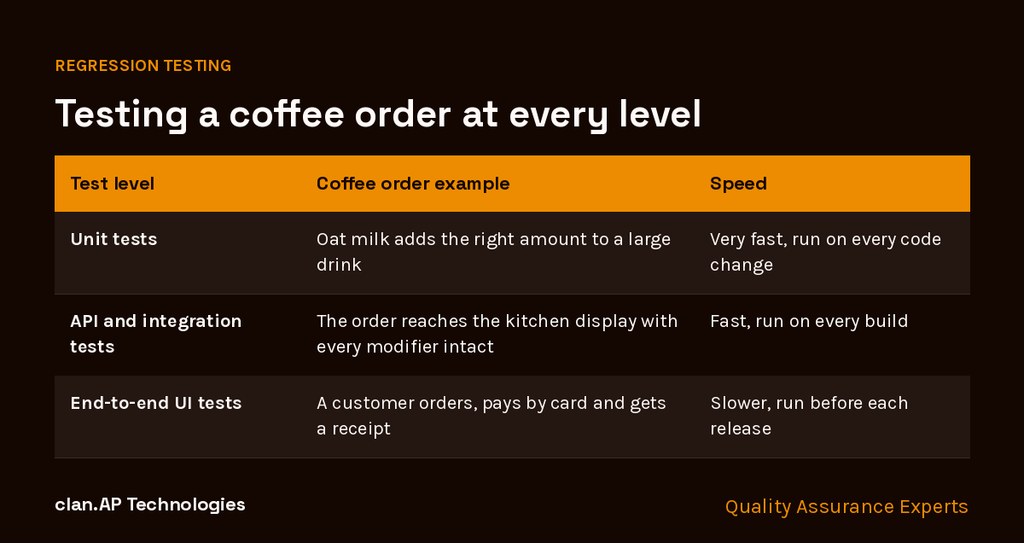
This balance keeps feedback fast for developers while still proving the full customer journey works.
Testing lesson: every release puts yesterday’s features at risk.
8. Someone has to use the screen
More cafés now let customers order on a kiosk or phone. That puts the software directly in the customer’s hands, with no staff member to cover for a confusing screen.
Usability and accessibility testing asks simple questions. Can a first-time customer find oat milk without help? Is the text readable in a bright window? Do buttons work for someone with shaky hands or a screen reader? Does the app still make sense on an older phone with a small screen?
These checks are easy to skip because nothing “breaks”. But a customer who cannot finish an order is a sale lost just the same.
Testing lesson: working is not the same as usable.
Where AI-assisted QA fits
Building a regression suite for hundreds of order paths takes time. At clan.AP Technologies, we use AI tools to build test scripts faster, and a QA expert reviews every script before it reaches the client. You get speed, plus the judgement that comes from real domain experience in Food & Hospitality POS, payments and fintech.
Here is how that works in practice:
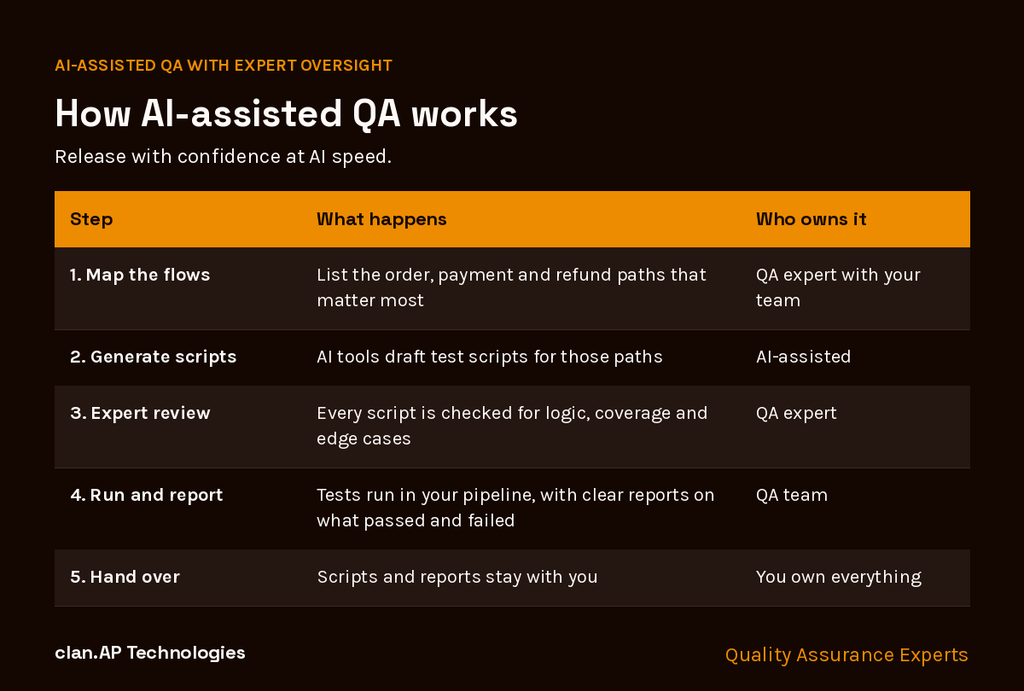
The scripts are yours. You own everything we build, with no lock-in, and we can usually be up and running in days.
Frequently asked questions
What is POS software testing?
POS software testing checks that a point of sale system handles orders, pricing, payments, refunds and integrations correctly. It covers the normal flow and the edge cases, such as declined cards, partial refunds and items going out of stock mid-order.
What are edge cases in software testing?
Edge cases are unusual but real situations a system must handle, like a customer changing an order after payment or a discount expiring during checkout. They are easy to miss and often cause the bugs users notice most.
Why is regression testing important for POS systems?
POS systems change often, with new menu items, offers and integrations. Regression testing checks that each change has not broken existing flows like pricing, payments and receipts. Automating it lets teams release faster with less manual effort.
Can AI write test scripts for a POS system?
AI tools can build test scripts faster, but they still need expert review. At clan.AP Technologies, AI-assisted scripts are always checked by a QA expert before they reach the client, so speed never comes at the cost of reliability.
How do I know where my POS testing has gaps?
Start with the flows that affect revenue and trust most: payments, refunds and order handoffs to the kitchen. If you want a second pair of eyes, book a 30-minute discovery call and we will talk through your product with you.
What is pairwise testing?
Pairwise testing picks a small set of test cases that covers every pair of option values at least once. It works because most software failures come from one or two settings interacting, so it finds many bugs with far fewer tests than trying every combination.
Does QA help with PCI DSS compliance?
QA does not replace a formal PCI DSS assessment. It can support it by checking that card data stays out of logs, receipts and error messages, and that payment flows fail safely.
Release with confidence at AI speed
One coffee order holds requirements, combinations, edge cases, integrations, payments, load, regression and usability. Your product holds thousands of them every day.
If you build POS, ordering or payments software and want faster test coverage without losing human judgement, let’s talk. Book a 30-minute discovery call and we will look at where AI-assisted QA with expert oversight fits your release cycle.