
Uncategorized

When Your POS System Breaks Mid-Dinner Rush, QA Stops Being Technical

When Your POS System Breaks Mid-Dinner Rush, QA Stops Being Technical There’s a specific kind of failure that no dashboard prepares you for. It’s 8:15 PM on a Saturday. The weekend crowd is pouring in. Tables are full. Orders are stacking faster than the kitchen can process them. Delivery riders are waiting near the counter. A customer taps their card again while another asks why their bill hasn’t printed yet. Then it happens. The receipt printer freezes. The POS stops responding. The staff starts panicking.And at that moment, quality assurance is no longer a backend function. It becomes the difference between a restaurant running smoothly and complete operational chaos. This was the reality for a restaurant POS platform before Clan-AP Technologies stepped in. This Wasn’t a Bug Problem. It Was a System Failure What looked like “issues” on the surface were actually symptoms of something deeper: No structured QA process No regression testing No consistency across devices No validation between frontend actions and backend responses So problems didn’t just exist, they multiplied. A deployment would fix one issue and quietly break another. Payment terminals would fall out of sync. Printers would stop mid-service. The same feature behaved differently on desktop and mobile. And the most expensive issue of all? No one knew what would break next. In a live restaurant environment, unpredictability is failure. Building QA Like Infrastructure, Not Cleanup Instead of patching issues, Clan-AP rebuilt the foundation. The first step wasn’t tools. It was understanding reality. How does a cashier actually use the system during peak hours? What happens when a driver gets reassigned mid-order? What if a payment goes through but doesn’t reflect in the system? From this, the team built a real-world testing layer: 1,000+ test cases covering actual workflows and edge scenarios Role-based testing across cashiers, customers, and delivery staff API validation to ensure backend accuracy not just UI behavior Because in systems like these, what looks correct isn’t enough. The data has to be right. The Hard Part: Testing Beyond Software Most QA strategies break when hardware enters the picture. Payment terminals. Receipt printers. Device sync issues. These aren’t clean, predictable environments. They fail in messy, real-world ways. Clan-AP approached this deliberately: Repeated hardware integration testing Validation across different device states Ensuring software and physical systems stayed in sync under stress Because in a restaurant, a delayed print or failed transaction isn’t a minor operational disruption. Automation Changed the Speed of Everything Manual testing can find issues. But it can’t keep up with continuous change. So Clan-AP built a Playwright automation framework using the Page Object Model designed for scalability and maintainability. More than 900 automated test scripts Both desktop and mobile coverage designed to change as the user interface does The actual change then occurred: The CI/CD pipeline incorporates automation.  Every build triggered the test suite. Which meant: Bugs were caught within minutes not after release Regressions stopped reaching production Developers could ship without second-guessing existing code This isn’t just efficiency. It’s a different way of building software. What Actually Changed The measurable impact: 30% faster issue detection and resolution 50% reduction in manual testing effort 900+ automated test cases running continuously But the real shift wasn’t in numbers. It was in behavior. Engineering teams stopped firefighting. They started building. As the client put it: “We’ve been able to scale our product with confidence and focus more on innovation rather than troubleshooting.” That’s what good QA does. It doesn’t just prevent problems, it gives time back. When Systems Work, People Don’t Notice. That’s the point. For restaurant staff, the change was simple: The system behaved consistently Payments processed reliably Printers worked when needed Nothing “randomly broke” mid-service Which meant they could focus on customers not software. And that’s the real benchmark of quality: When technology disappears from the experience. The Takeaway Most Teams Miss QA is still treated as a final checkpoint in most products. Something you do before release. Something you “add” later. That approach guarantees one thing: You’ll always be reacting. The alternative is harder but far more valuable: Treat QA as infrastructure Build it early Automate what repeats Connect it directly to your deployment cycle Because if your system only works when nothing goes wrong, it isn’t stable, it’s lucky. And in high-pressure environments, luck runs out fast. If your product has ever broken under real usage, not just test conditions, you’re not dealing with isolated bugs. You’re dealing with a system that hasn’t been tested the way it’s actually used. That’s where the real work begins.


Release Stability: The Metric Every CTO Should Track

Release Stability: The Metric Every CTO Should Track Most engineering teams no longer struggle with speed. CI/CD pipelines are optimized, deployments are frequent, and releases happen faster than ever. Yet something still feels off. Bugs slip through. Rollbacks happen quietly. Customer trust erodes, not with crashes, but with inconsistency. The issue isn’t velocity. It’s release stability. What is Release Stability (and why it matters more than velocity) Release stability isn’t just about “fewer bugs.” It’s about how predictably your system behaves after every release. A stable release means: No unexpected regressions No performance drops under real usage No silent failures in edge cases No emergency fixes post-deployment In short, stability is what turns deployment into confidence. And here’s the uncomfortable truth: Most teams measure success by how fast they ship, not how safely users experience it. The Hidden Cost of Unstable Releases Unstable releases rarely fail loudly. They fail silently. A checkout takes 2 seconds longer. A payment API times out once in 200 calls. A feature works, but not consistently. Individually, these seem minor. Collectively, they cost you: User trust → once lost, rarely recovered Engineering time → endless debugging cycles Business momentum → growth slows without clear reasons In high-stakes domains like fintech or SaaS, even small inconsistencies directly impact retention and revenue. Why Most Teams Get This Wrong The problem isn’t lack of testing. It’s when and how testing happens. Traditional QA still operates like a checkpoint: Build → Test → Fix → Release But modern systems don’t behave linearly. They evolve continuously. So what happens? QA becomes reactive instead of predictive Automation exists, but doesn’t reflect real-world scenarios Users, not systems, discover edge cases The result: speed increases, but stability decreases. What High-Performing Teams Do Differently Teams that consistently ship stable releases treat quality as a system, not a phase. They focus on: Continuous validation, not final-stage testing Production-like test environments Risk-based test coverage (not just code coverage) Real-time feedback loops from live systems Most importantly, they measure one thing relentlessly: “How often does a release behave exactly as expected?” That’s release stability. Where Clan-AP Changes the Game This is where clan-AP operates differently. Instead of treating QA as a service, Clan-AP embeds quality engineering across the entire lifecycle from early development to post-release validation. What that means in practice: QA is integrated into your CI/CD, not added after it Automation is aligned with real user behavior, not just scripts Performance, API, and functional testing work as one system, not silos Releases are validated for stability, not just correctness This shift is subtle but powerful. Because when QA is embedded, releases stop being risky events and start becoming repeatable outcomes. The Real Competitive Advantage In 2026, speed is no longer a differentiator. Everyone ships fast. The companies winning today are the ones whose products: Don’t break under scale Don’t surprise users Don’t require constant fixes They feel… reliable. And reliability is what compounds growth. Final Thought If you’re a CTO, ask yourself one question: “Do our releases feel predictable or hopeful?” Because if you’re still relying on velocity as your north star, you’re optimizing for the wrong outcome. The future belongs to teams that don’t just ship fast, but ship stable. And the gap between those two is exactly where companies like Clan-AP are building their edge.

Why Product Teams Need QA Visibility Across the Development Lifecycle

Why Product Teams Need QA Visibility Across the Development Lifecycle It usually starts with a small miss A feature gets shipped on time. Everything looks fine on the surface. But a few days later, users start reporting issues, something feels off, a workflow breaks, and performance drops in certain scenarios. Nothing catastrophic, but enough to create friction. This is a common pattern in product teams that move fast but lack one thing: clear QA visibility across the development lifecycle. The issue is not effort. It is visibility. What “QA visibility” actually means QA visibility is not just about testing at the end. It is about understanding how quality is tracked, validated, and improved at every stage, from planning to release. When QA is visible across the lifecycle, teams know: What has been tested and what has not Where risks exist How stable a release really is Which areas need more attention before going live Without this, teams often make release decisions based on incomplete information. What happens when QA is not visible When QA is treated as a final step instead of a continuous process, problems start to build quietly. Product teams may experience: Features passing development but failing in real usage Repeated regressions after new releases Delays caused by last-minute bug discoveries Misalignment between product, engineering, and testing teams Over time, this creates a reactive cycle teams spend more time fixing issues than building new value. Why product teams struggle with this In many organizations, QA exists, but visibility does not. This usually happens because: Testing is disconnected from product planning There is limited tracking of test coverage and risks Communication between teams is inconsistent QA insights are not integrated into decision-making As a result, quality becomes something teams check, not something they manage. Quality is not a phase, it is a system Modern product teams cannot rely on last-minute testing to ensure quality. With faster release cycles and growing product complexity, visibility becomes critical. QA is most effective when it is built into the system, not added at the end. When teams can see how quality evolves throughout development, they are better equipped to deliver consistent and reliable products. How Clan-AP supports QA visibility Through providing Product teams with Visibility to their Testing History by implementing a consistent structure, reporting, and Consistent Alignment throughout all Development Stages, “Clan-AP” helps Product teams achieve clarity on their QA practices, as well as providing Confidence in releasing higher-quality products with fewer unexpected issues. Clan-AP’s approach to improving how teams track and Manage Quality has allowed Product teams to increase their release confidence and provide a smoother experience for their end users. Conclusion Lack of QA visibility does not always cause immediate failure, but it often leads to slower releases, repeated issues, and reduced confidence over time. Product teams that prioritize visibility are able to move faster without losing control over quality.

How QA Teams Help SaaS Platforms Protect Revenue

How QA Teams Help SaaS Platforms Protect Revenue Small issues can turn into real business losses In SaaS, revenue is not only about getting customers in. It is also about keeping the product working smoothly enough that they want to stay. That is why even a small bug can have a bigger impact than most teams expect. A payment problem, a broken feature, a slow dashboard, or an issue during onboarding can interrupt the user experience at the worst possible moment. And when that happens, the damage is not always loud or immediate. Sometimes it shows up quietly through failed renewals, support complaints, lower usage, or customers slowly losing trust in the platform. In SaaS, product quality and revenue are more connected than they seem. Why testing matters more than many teams realize A lot of people still think testing is mainly about finding bugs before launch. But in reality, good QA helps protect the parts of the product that matter most to the business. It helps make sure users can sign up easily, complete payments, use core features without friction, and move through the platform without confusion or disruption. That matters because users do not judge a SaaS company by how fast it ships features. They judge it by whether the product works when they need it. If the experience feels unreliable, they start questioning the product. And once that doubt builds up, retention becomes much harder. QA helps teams catch problems before users do This is where QA teams make a real difference. They check whether new releases have affected existing features, test important user journeys, and spot issues before they reach production. In fast-moving SaaS teams, that kind of support is essential. Without proper testing, updates can easily create new problems while trying to solve old ones. A small release can affect billing, integrations, dashboards, or workflows in ways the team did not expect. When users find those problems first, the company ends up paying for it through lost trust, internal firefighting, and missed revenue opportunities. Better quality leads to stronger retention In subscription businesses, consistency matters a lot. Customers stay when the platform feels stable. They renew when it continues to deliver a smooth experience. They recommend it when they trust it. That is why QA is not just helping with software quality. It is helping with customer confidence. A reliable platform reduces frustration, lowers churn risk, and creates the kind of experience that supports long-term growth. It gives teams more confidence to release, and users more confidence to stay. Conclusion QA teams help SaaS businesses protect far more than their product. They help protect user trust, retention, and the revenue that depends on both. In a space where even small issues can create lasting damage, strong testing is not just a support function. It is part of building a business that lasts. How Clan-AP helps Clan-AP helps SaaS businesses improve product reliability through structured testing, consistent quality checks, and support that fits growing platforms. By helping teams catch issues early and release with more confidence, Clan-AP supports the kind of smooth product experience that keeps users satisfied and revenue better protected.

Why SaaS Companies Fail Without a Structured QA Strategy

Why SaaS Companies Fail Without a Structured QA Strategy In SaaS, speed is often treated as the ultimate advantage. Teams push frequent updates, roll out new features, and iterate rapidly. But without a structured QA strategy, that same speed becomes the reason many SaaS products fail. The issue is not a lack of development capability, it’s the absence of a consistent, scalable quality assurance process. The Hidden Risk Behind Fast Releases SaaS products operate in live environments where updates are continuous. A single bug doesn’t just affect one release it impacts active users in real time. Without structured QA: Bugs reach production more frequently Fixes create new issues (regression problems) User trust begins to erode Speed without control leads to instability. Inconsistent Testing Creates Unpredictable Products Many SaaS teams rely on ad-hoc or manual testing, especially in the early stages. While this may work initially, it quickly becomes unsustainable. As the product grows: Features become interconnected Edge cases increase Testing complexity multiplies Without a defined QA framework, testing becomes reactive instead of proactive. Lack of Automation Slows Everything Down Automation is not optional in SaaS, it’s foundational. Without it: Every release requires repetitive manual testing Testing cycles become longer Teams hesitate to ship updates Structured QA introduces automation where it matters, enabling faster and more reliable releases. Poor QA Impacts User Experience Directly Users don’t see your code, they experience your product. Unstructured QA often results in: Broken user flows Performance issues Inconsistent behavior across devices Even small issues compound into a poor user experience, leading to churn. Scaling Without QA is Unsustainable As SaaS companies scale, so do their risks. Without structured QA: Bug backlogs grow faster than they are resolved Releases become unpredictable Teams spend more time fixing than building A structured QA strategy ensures testing scales with the product. What a Structured QA Strategy Looks Like Effective QA in SaaS includes: Defined testing processes and workflows Automation integrated into development pipelines Continuous testing across environments Clear reporting and quality metrics Collaboration between QA and development teams This transforms QA from a checkpoint into a continuous system. Conclusion SaaS companies don’t fail because they build too fast  they fail because they don’t validate fast enough. A structured QA strategy brings stability to speed, ensuring that growth doesn’t come at the cost of quality. If your product is scaling but your QA process isn’t, it’s only a matter of time before quality issues start slowing you down. Clanap helps SaaS businesses build structured, scalable QA strategies with expert testing teams and automation-driven processes. Build better. Release with confidence.

What to Expect When You Outsource QA Testing

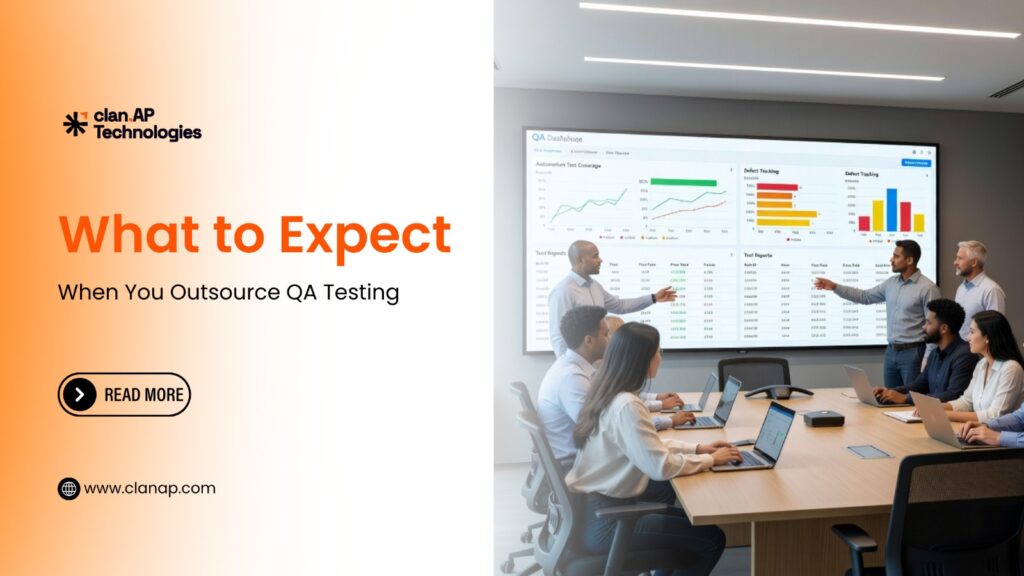
What to Expect When You Outsource QA Testing Companies are using quality assurance outsourcing today for a variety of reasons. Companies now use QA outsourcing not only as a way to save cost but as part of the overall strategy of many technology-driven businesses to accelerate product delivery, ensure quality product reliability, and allow for a seamless user experience on all platforms. A common issue that companies encounter when they first begin using a vendor to perform QA testing is that the companies involved have not defined their respective expectations. This results in delays in production,a lack of effective communication, and ultimately provides the company with less value than expected for the money being spent. The following outlines reasonable expectations to establish for a successful partnership in QA testing and realistic events that will occur in the process of outsourcing QA testing. 1. Faster Testing Cycles, Not Instant Results A professional QA partner brings structured workflows, predefined testing frameworks, and experienced engineers. This typically reduces testing turnaround time significantly. That said, outsourcing does not eliminate onboarding time. Initial phases involve: Understanding product architecture Setting up environments Aligning test strategies Defining reporting standards Once stabilized, testing cycles become noticeably faster and more predictable. Expectation: Gradual acceleration, not overnight transformation. 2. Access to Specialized Expertise An outsourced QA team often provides skills that are expensive or difficult to maintain internally. This may include: Automation testing Performance and load testing Security validation Cross-device and cross-browser testing API and integration testing Instead of hiring multiple specialists, companies gain immediate access to a diversified testing capability. Expectation: Broader technical coverage without expanding internal headcount. 3. Improved Product Quality Through Objectivity Internal teams can develop familiarity bias toward their own product. External QA teams approach testing without assumptions. This leads to: More realistic user-scenario testing Identification of overlooked edge cases Early detection of usability issues An independent QA perspective frequently uncovers defects missed during internal development cycles. Expectation: More critical feedback, which ultimately strengthens product quality. 4. Clear Communication Becomes Critical Outsourcing success depends less on tools and more on the communication structure. Effective QA partnerships typically include: Defined reporting cadence Shared dashboards Bug prioritization workflows Regular sprint alignment meetings Without structured communication, even skilled teams struggle to deliver consistent outcomes. Expectation: Collaboration, not delegation. 5. Scalable Testing Capacity One of the strongest advantages of outsourcing QA is flexibility. You can: Scale testing during major releases Reduce resources during maintenance phases Support multiple product versions simultaneously This elasticity helps organizations manage fluctuating development workloads efficiently. Expectation: Testing resources aligned with business demand. 6. Measurable Processes and Reporting Professional QA providers operate with metrics-driven systems such as: Test coverage reports Defect density analysis Automation success rates Release readiness indicators These insights improve decision-making and reduce release risks. Expectation: Data-backed visibility into product quality. 7. Long-Term Strategic Value Outsourced QA evolves beyond defect detection. Over time, partners contribute to: Process optimization Automation strategy Continuous integration improvements Faster go-to-market cycles When integrated properly, QA outsourcing becomes part of the product development strategy rather than an external service.

QA Challenges in Healthcare Software and How to Solve Them

QA Challenges in Healthcare Software and How to Solve Them It starts with real industry context, identifies the reader’s pain points, and leads into how a modern quality partner can help, without sounding like a hard sell. Every Second Matters: A Startling Reality in Healthcare Software In 2024, healthcare software was estimated to handle more than 3 billion patient interactions globally each month, from appointment bookings to telehealth sessions to digital prescriptions.But here’s the concerning part:Up to 68% of healthcare systems report software reliability or user experience issues at least once a quarter. In an industry where lives depend on accuracy, where medical decisions are made in real time, and where regulatory penalties can reach millions, software quality isn’t just fundamental, it’s imperative. This is the landscape tech leaders and healthcare product teams are working in today. And the stakes could not be higher. The Healthcare QA Dilemma: Why Problems Are Hard to Spot… Until It’s Too Late Healthcare products are complex. They are built to manage: Electronic Health Records (EHR/EMR) Medical device integrations Telemedicine workflows Patient data privacy and compliance Insurance claims and billing Real-time alerts and diagnostics In such a sensitive ecosystem, weak quality assurance isn’t just inconvenient it can be catastrophic. Yet many teams still struggle with QA because the challenges aren’t always obvious. What Makes Healthcare QA So Tough? Healthcare product teams face unique hurdles: Regulatory ComplexityHIPAA, GDPR-Health, and FDA software guidelines compliance is not optional. Every change must be validated against rules that evolve constantly. Security Isn’t an Afterthought, It’s the Core RequirementHealthcare data breaches cost more than most industries. QA needs to validate not just functionality, but security integrity under real conditions. Integration OverloadApps must talk to labs, imaging, pharmacy systems, device monitors, and often through APIs that change without warning. Multi-User, Multi-Role LogicDoctors, nurses, administrators, patients, and payers all see different screens and workflows. Testing must account for every perspective. Performance Under PressurePeak traffic during outbreaks, natural disasters, or hospital surges can expose performance problems that never showed up in staging. Data Accuracy Needs Zero ToleranceA rounding error in billing might be catchable. A rounding error in dosage calculation is life-threatening. Common Pain Points Product Teams Face (and That Users Feel) Even well-intentioned development teams run into these traps:  “It worked fine in testing…” But not in production — and there’s a gap between environments.  Manual testing overload Every release feels heavy with regression risk and repetitive test suites.  Missed edge cases A rare workflow, like emergency update + simultaneous barcode scan + offline device, breaks in production. Slow release cycles Teams delay releases by days or weeks because QA is done last.  Fragile integrations A partner API change and suddenly, lab results stop syncing reliably. These issues don’t just show up in bug reports they show up in support escalations, compliance audits, and patient frustration. How ClanAP Technologies Helps Healthcare Teams Win at QA Modern healthcare QA needs expertise, scale, and intelligence, not just tools. That’s where partners like Clan-AP Technologies play a strategic role. They help teams: Build QA pipelines into DevOps So quality is no longer a bottleneck, but an enabler of faster, safer releases. Develop smart automation coverage Focusing on the tests that give the highest confidence with the least maintenance cost. Validate regulatory and security compliance Including HIPAA, GDPR, and domain-specific requirements that most CI/CD tools don’t cover natively. Simulate real user and edge-case behavior Using advanced scenario testing to catch where traditional QA misses. Provide real-world observability Turning production feedback into actionable quality insights. In a world where “software failure” can mean clinical errors, data breaches, or compliance penalties, quality isn’t a technical best practice, it’s a business imperative. Final Thought: Quality Is Patient Safety Not Just Code Correctness Quality in healthcare isn’t about defect counts or test coverage percentages.It’s about trust: Trust patients place in their providers Trust clinicians place in their tools Trust payers place in your systems Trust regulators place in your compliance When QA is strong, systems behave predictably even under pressure. When QA is weak, even minor issues become major risks. Healthcare software cannot afford to compromise on quality.

Why FinTech Products Cannot Afford Weak QA

Why FinTech Products Cannot Afford Weak QA In most industries, a small bug is an inconvenience. In FinTech, it’s a risk. A delayed transaction. An incorrect balance. A failed verification step. A payment that doesn’t go through at the right moment. These aren’t just technical problems they directly affect money, compliance, and trust. And in FinTech, trust is everything. Once users lose confidence in a platform, they don’t usually give second chances. That’s why weak QA isn’t just a quality issue in FinTech.  It’s a business threat. FinTech Runs on Trust, Not Just Technology People don’t choose FinTech products because they ship fast or look modern. They choose them because they believe their financial data and transactions are safe. A FinTech app can work most of the time, but that remaining small percentage of failure is what defines the user experience. One wrong transaction or one confusing error message is enough for a customer to question the entire platform. Unlike other digital products, FinTech users don’t tolerate uncertainty. If something feels off, they leave. Weak QA doesn’t just introduce bugs. It introduces doubt. Speed Without Quality Creates Risk FinTech teams operate under constant pressure, new features, new integrations, new compliance requirements, and new markets. The push to move fast is real. But when speed comes without strong QA, the consequences add up quickly. Teams start seeing broken payment flows, inconsistent calculations, failures under peak load, or unexpected behavior across devices and regions. Fixing these issues after release isn’t just costly, it can trigger regulatory attention, financial losses, and reputational damage that no quick patch can fully repair. In FinTech, “we’ll fix it later” is rarely an option. Compliance Leaves No Room for Error FinTech operates in one of the most tightly regulated environments. Security standards, data privacy laws, and financial compliance rules must be followed precisely. Weak QA can result in audit failures, data exposure, non-compliant workflows, or security gaps that only appear under real-world conditions. And regulators don’t care how innovative your product is if it can’t meet basic reliability and safety expectations. Strong QA acts as a safeguard protecting not just users, but the entire business. Integrations Multiply the Risk Modern FinTech platforms don’t exist in isolation. They depend on banks, payment gateways, KYC providers, fraud detection systems, and third-party APIs. Every integration adds another layer of complexity and another potential point of failure. Without proper QA, small changes in external systems can silently break critical flows. Transactions may fail, data may stop syncing, or authentication may behave inconsistently. These issues often go unnoticed until users start reporting problems. Weak QA doesn’t just miss bugs. It misses chain reactions. Performance Issues Hurt FinTech Faster Than Anything Else A FinTech app can technically be “working” and still fail its users. Slow loading during peak hours. Delayed confirmations. Lag during transfers. These don’t always show up as errors, but they create anxiety. When money is involved, even a few seconds of delay feels serious. Users don’t care about backend complexity they care about confidence. In FinTech, QA isn’t only about correctness. It’s about reassurance. Weak QA Slows Growth Instead of Accelerating It Ironically, teams that cut corners on QA often end up moving more slowly. They spend more time firefighting production issues, handling support escalations, managing rollbacks, and responding to compliance concerns. Product roadmaps slip. Engineering teams burn out. Innovation takes a back seat. Strong QA enables confident releases. Weak QA creates reactive cycles. Over time, this difference becomes visible in how fast and how safely a FinTech company can scale. The Real Question Isn’t “Can We Invest in QA?” For FinTech products, the real question is: Can we afford not to? Because in an industry built on trust, reliability is the product. QA is what protects that reliability. Where ClanAP Technologies Comes In At ClanAP Technologies, we work with FinTech teams to strengthen their QA foundations from automation and integration testing to performance, security, and real-world scenario validation. Our focus is simple: help FinTech products stay stable, compliant, and trustworthy as they grow. Because in FinTech, users don’t remember how quickly you shipped a feature. They remember whether they could trust you with their money.

7 Silent Bugs That Kill User Experience Without You Noticing

7 Silent Bugs That Kill User Experience Without You Noticing When most people think of bugs, they imagine an app crash, a broken button, or a blank screen. But the truth is far more dangerous: the bugs that damage user experience the most are usually the quiet ones. The ones that don’t fully break a feature but break a user’s patience. These silent bugs slip through development unnoticed. They’re small enough to ignore but powerful enough to push users away without ever telling you why. Let’s explore the seven hidden UX killers that slowly erode trust and performance, often going undetected for months. 1. Slow Micro-Interactions That Make Your Product “Feel” Slow Your backend may be lightning fast, but if small interactions lag, like clicking a button, opening a menu, or switching tabs, users feel the drag immediately. It’s never bad enough for a support ticket. But it’s bad enough for a user to lose interest silently. Users don’t measure speed in metrics. They measure it emotionally. And if your product feels slow, they quietly leave. 2. Inconsistent UI Behavior That Confuses the Brain One button fades in. Another slide from the right. A third simply pops. Individually, they’re fine. Together, they create friction, a tiny bit of confusion that interrupts flow. Inconsistency is one of the most silent UX killers, because users rarely complain about it. They simply don’t “enjoy” using the product, without knowing why. When the brain cannot predict the interface, it stops trusting it. 3. Forms That Fail at Guiding Users Smoothly A form error that appears too late. A required field that doesn’t highlight. A dropdown that doesn’t scroll smoothly on mobile. Tiny issues, but massive blockers. Users don’t write angry emails about forms. They just abandon them. Silent form bugs directly kill conversions, onboarding success, and lead quality, all without ever showing up as “bugs.” 4. Search That Works but Isn’t Actually Helpful Search bugs are some of the quietest killers in UX. Your search box may “work,” but:  Does it show the right results? Does it surface relevant items? Does it ignore spelling variations? Does it fetch outdated or incomplete listings? Users think your app lacks the content they need. You think your app is fine. But the revenue quietly slips away in the background. Silent search bugs rarely break functionality, they break discovery. 5. Session Timeouts That Break User Trust Few things frustrate users more than being logged out mid-task. Perhaps they were filling out a form and uploading documents, reviewing financial details. A sudden timeout feels like losing progress, losing control, and losing trust. Security matters, but poorly timed session expiries push users away faster than obvious errors do. 6. Notification Glitches That Create Confusion Notifications that don’t refresh. Badges that don’t clear. Read/unread indicators that lag. These don’t stop the product from working, but they destroy clarity. Users depend on notifications for communication. When those cues break, the entire experience feels unreliable. Silent notification bugs break confidence quietly but effectively. 7. Accessibility Issues That Affect Everyone (Not Just a Few) Accessibility bugs are often overlooked because they don’t stop the system from running. But they do stop users from comfortably using the system. Low contrast text, poorly sized buttons, unreadable icons, and missing keyboard navigation don’t “crash functionality”, they crash usability. And these issues harm all users, not just those with disabilities. Silent accessibility bugs are universal friction points disguised as design choices. Why Silent Bugs Are So Dangerous Silent bugs don’t show up in error logs. They don’t create alerts. Users don’t bother reporting them. Instead, they show up as: declining engagement, increased churn, abandoned sessions, lower conversion rates, decreased product satisfaction. By the time teams catch on, the damage is already done. This is why modern QA isn’t just about checking boxes. It’s about understanding the emotional flow of a user’s journey, and protecting it. How to Catch These Bugs Before They Hurt Your Product Silent bugs require a smarter testing approach. Not just functionality testing, but experience testing. This includes: exploratory testing to find odd behaviors, automation for consistent flows, cross-device and cross-browser validation, micro-performance testing to catch subtle delays, real-user journey testing instead of isolated checks. Silent bugs hide where teams don’t look. The solution is to test beyond “does it work?”and move toward “does it work correctly, consistently, and pleasantly for every user?” Where Clan-AP Comes In  At Clan-AP Technologies, we don’t just test for errors, we test for experiences. We help companies uncover the invisible issues that impact user trust, retention, and satisfaction. Through a blend of automation, real-world scenario testing, UX-focused QA, and performance validation, we ensure your product doesn’t just function, it feels flawless.Because in today’s digital world, users rarely complain. They simply leave. And our job is to make sure they never need to. If you want your product to stay sharp, smooth, and silently impressive, Clan-AP Technologies is here to make that happen.

Inside Fintech QA: How Automation Is Powering Secure Digital Transactions in 2026

Inside Fintech QA: How Automation Is Powering Secure Digital Transactions in 2026 Fintech in 2026 is not just faster, it’s more complex, more connected, and far more demanding than ever before. Users are sending cross-border payments in seconds, approving loans instantly through apps, and verifying identities with biometrics. Behind every tap, swipe, and instant approval lies a system that must work perfectly. Because in fintech, even the smallest glitch has a price. This is why Quality Assurance has evolved into one of fintech’s most critical functions. And in 2026, automation will have become the backbone of fintech QA. Why Fintech QA Matters More Than Ever Fintech products deal with money, identity, and security, the three things users never compromise on. When a payment fails or a verification step breaks, users don’t wait for updates or explanations; they immediately question the platform’s reliability. Add the scale of today’s fintech ecosystem: instant payments, digital wallets, embedded banking, buy-now-pay-later systems, crypto and digital assets, open banking APIs, and AI-driven fraud engines. Testing all of this manually is impossible. Fintech moves in milliseconds, and QA must match that speed. That’s exactly where automation transforms how fintech products stay secure and stable. The Speed, Security Challenge Fintech companies are under pressure to innovate faster than ever. New features, new integration partners, new compliance changes, everything is moving at lightning speed. But speed introduces risk. Every code change, every API update, every enhancement carries the potential to break something critical. And when your product handles money, a “small issue” isn’t small at all. The challenge for fintech in 2026 is simple:How do you build faster without compromising security, accuracy, or customer trust? The answer is Continuous, Automated QA, built directly into the development pipeline. How Automation Is Transforming Fintech QA Real-Time Transaction Validation Fintech no longer works in batch cycles. Payments clear instantly, balances update in real time, and transaction histories appear within seconds. Automation allows testing of thousands of transactions at once, ensuring they: process correctly, reconcile accurately, update ledgers properly, trigger fraud systems when needed. Manual testing can’t even come close to keeping up with real-time fintech traffic. Stronger Integration Testing Fintech apps integrate with dozens of external systems, banks, card networks, payment gateways, AML/KYC providers, fraud engines, and more. Every integration is a potential failure point. Automated tests run continuously to validate that each connection is functioning properly, even when third-party systems update without notice. Automation protects fintech apps from breaking due to changes they don’t even control. Compliance and Security Assurance Regulations like PSD2, FCA guidelines, GDPR, SOC2, and Open Banking standards evolve constantly. Manual validation of compliance can take weeks and create bottlenecks. Automation ensures: required fields are captured, logs are recorded, data is encrypted, flows follow regulatory rules, and security gates remain intact. It reduces audit stress and ensures fintech companies remain compliant every time they deploy. Performance & Stress Testing at Scale One of the biggest risks in fintech is performance failure during heavy load, think salary days, holiday sales, or viral spikes. Automation simulates: millions of transactions, intense concurrency, peak stress conditions, failover switchovers, disaster recovery scenarios. This ensures the system remains stable even at its limits. Smarter Fraud Detection Testing AI-driven fraud systems constantly evolve. Automation helps test fraud detection logic to ensure: real threats are caught, false positives stay low, New fraud patterns trigger alerts properly. Without automation, the fraud layer becomes unpredictable and risky. End-to-End Journey Testing Fintech customer journeys are long and sensitive: Login → KYC → Card Linking → Transaction → Notification → Statement Update Automation tests the full journey across: devices, regions, currencies, languages, and varied network conditions. It ensures users never face broken flows at critical steps. Why Automation Has Become a Fintech Standard For fintech companies, automation provides: Higher accuracy Faster releases Fewer production issues Better customer trust Lower support costs Stronger security Compliance confidence Peace of mind But above all, it provides reliability. And reliability is the foundation of fintech success. Where Clan-AP Comes In? At Clan-AP Technologies, we know that fintech innovation only works if it’s backed by flawless execution. That’s why we help fintech companies build powerful QA automation systems that protect every transaction, every integration, and every user journey. We work with teams to: automate complex financial workflows, validate payment engines, strengthen compliance testing, run large-scale performance tests, secure every API and integration, and ensure seamless, fail-proof user experiences. Our mission is simple: Help fintech products move faster, without ever breaking trust. Because in the world of digital finance, quality isn’t just important,  it’s everything.